Hungarian Wizz Air overtakes struggling SkyEurope
Christopher Adam
Hungarian low-cost carrier Wizz Air has now clearly overtaken its main regional rival, Slovakia’s SkyEurope. Once Eastern Europe’s largest discount airline, SkyEurope has failed to turn a profit since its founding in 2002 and was forced to file for creditor protection in June 2009. Since then, the Slovak carrier’s woes have only gotten worse. The carrier failed to reach a deal with Vienna’s Schwechat Airport last Friday, which led to the cancellation of all flights from SkyEurope’s Central European hub. SkyEurope reportedly has a significant outstanding debt with airports in both Vienna and Prague and as such, Schwechat has decided to stop servicing all SkyEurope flights.
In an effort to stop the carrier from going under, SkyEurope has transferred all of its Vienna-based flights to Bratislava’s Letisko M. R. Štefánik Airport and passengers are being offered free coach service from Vienna. Despite these efforts and the relatively short 59km distance between the two hubs, the majority of SkyEurope passengers are experiencing lengthy delays. (tovább…)
The death of Hungarian socialism?
Christopher Adam
Hungarians usually refer to the doldrums of August as the “pickle season.” In a modest parallel to Canada’s cottage season, many Hungarians traditionally flee their city apartments to work tiny plots of land behind weekend houses, the majority of which were granted to them during the bygone days of socialism. But this year is different, in that Hungary finds itself at the cusp of seismic political change, which is likely to transform the country. This sense of imminent transition permeates society, as the left teeters on collapse and as the right looks set to win the most massive parliamentary majority in the European Union.
At the centre of this transformation is the imminent collapse of the Hungarian left, which has governed the country for nearly 12 out of the 20 years since the transition to democracy in 1989. Following a disastrous performance in the European parliamentary elections, the governing Socialist Party finds itself in the unhappy position of having only scored two percentage points more than an upstart far-right party and nearly 40% behind Fidesz, its main right-wing rival. (tovább…)
Hungarian Socialists suffer major defeat in European elections
| Party Lists | Percent | Seats | |
| Fidesz – Alliance of Young Democrats | 56.37% | 14 | |
| Hungarian Socialist Party (MSZP) | 17.37% | 4 | |
| Jobbik – Movement for a Better Hungary | 14.77% | 3 | |
| Hungarian Democratic Forum | 5.30% | 1 | |
| Alliance of Young Democrats (SZDSZ) | 2.16% | 0 |
Hungary’s centre-left parties, the Socialists (MSZP) and the liberal Free Democrats (SZDSZ), suffered a massive defeat during the June 7th European Parliamentary elections, as two right-wing party lists together won more than two thirds of the vote. The governing Socialists only managed to win 4 out of 22 seats allocated to Hungary in the European Parliament, losing five of the nine seats that it had garnered during the last EP elections, in 2004. The situation was far worse for the SZDSZ; the liberals failed to pass the 5% threshold necessary to win mandates and will therefore lose the two seats that they currenty hold in the European Parliament. Despite long odds, the liberal-conservative Hungarian Democratic Forum (MDF), however, was successful, and will keep its one mandate.
While the Hungarian centre-left vote collapsed, the right-wing won a landslide victory. Fidesz won 14 seats, while the far-right Movement for a Better Hungary (Jobbik) succeeded won a shocking and unexpected victory. Not only did Jobbik pass the 5 percent threshold, it far surpassed expectations by winning 3 seats and taking 14.77% of the vote. Jobbik’s surprisingly strong performance in this election will likely help it cement its position prior to national elections in spring 2010, when it will aim to pass the 5% threshold necessary to enter the Parliament of Hungary.
The turn-out for the EP elections in Hungary was slightly lower this year than in 2004. While 38.50% of eligible voters participated in EP elections five years, this proportion stood at only 36 percent in 2009.
Attila Mesterházy, the MSZP’s caucus leader, noted that the Socialists would continue to support the current government, led by recently appointed independent Prime Minister Gordon Bajnai, despite continuous calls on the part of Fidesz to hold early national elections this fall, instead of waiting until 2010.
Canadian Hungarian Journal
Hungarian studies conference and lectures in Ottawa
The Canadian Hungarian Journal and the Canada Hungary Educational Foundation are organizing a lecture evening at the University of Ottawa, on May 25, 2009 at 7pm, which will include presentations by three Hungarian academics. Historian Mária Palasik of the Historical Archives of Hungarian State Security in Budapest will begin the evening by discussing the role that women and technology have played in Hungarian universities, while Róbert Takács of the Institute of Political History will give a lecture on censorship and self-censorship under János Kádár’s communist regime. Márton Pászti of the Budapest University of Technology and Economics will complement the evening with a presentation on applied human-computer interaction.
Each lecture will be 20 minutes in duration and there will be an opportunity for discussion and debate. Complimentary refreshments will also be served by the organizers. The event is scheduled for May 25, 2009, at 7:00pm, in Tabaret Hall room 323, at the University of Ottawa. Please see the event’s poster for more information.
Our three presenters are travelling to Ottawa in order to participate at the annual conference organized by the Hungarian Studies Association of Canada (HSAC). This year’s conference is scheduled to take place at Carleton University on May 23-24, 2009, within the context of the Congress of the Humanities and Social Sciences. The HSAC conference programme includes a wide array of interdisciplinary presentations, as well as a talk by Hungarian-Canadian author Anna Porter.
We believe that most of you who are participating in this year’s conference, have registered through the fedcan Congress office, but if you have not done so please do so now. HSAC benefits from your registration. We will be circulating the information about the conference to some local community members who might be interested in attending. If you have friends and acquaintances in the Ottawa region, please alert them to this. Interested non-member individuals do not need to register for the Congress but are expected to pay a daily $15 fee for attending any association programs. If you just come to one or two lectures there is no need to pay this fee. The evening event with Anna Porter is free and open to the public.
We would like to draw your attention to a number of special features/events noted in the conference program:
1. As a pre-conference event, on Friday evening, May 22nd we are fortunate in having Tamás Szabó, curator from the Szeged Móra Ferenc Museum to talk to us about the Giorgio Vasari painting in the museum’s collection, as well as other aspects of the Szeged collection.
2. On Saturday 23rd, we have the talk by Anna Porter, preceded by a buffet supper in the same location. This replaces our usual dinner in a restaurant and we will need to charge for the costs of the supper (we are not yet sure of the amount but it will probably be $25 per person, including wine). This will be announced on the first day of the conference.
3. Finally, as a post conference event, on Monday May 25th at 10 am we have arranged a special visit /tour to the Library and Archives of Canada’s super-modern Preservation centre where staff will have a display of some of the Hungarian relevant materials of the national collection (books, archival materials, art and other visual material). We are grateful to the Embassy of Hungary for helping to transport participants to the Preservation Centre.
The location of the conference is at the Carleton University Campus in the Hertzberg building. However, the talk by Mr Szabo and by Anna Porter, as well as the lecture evening on May 25th, are on the campus of the University of Ottawa. Please take a careful look at the programs and the poster. Some of us locals will try to provide transportation certainly on Saturday evening from Carleton to Ottawa U for the supper and Anna Porter.
Logistics, and other useful information:
-The congress will distribute bottled water for each panel/session, but staff will ask the session chairs if they wish to “opt out,” for environmental reasons. Catered coffee breaks will still include bottled water as well.
Swine Flu Concerns:
-The congress is cooperating with Ottawa’s pandemic planning committee and with Carleton’s Health Services
-Hand sanitizers will be widely available on campus, especially in the Field House.
Information for Delegates:
-The Congress will set up an information desk at Ottawa’s MacDonald-Laurier Airport to assist visitors, but a similar booth will not be available at the train station.
-There will be shuttle service available from the Carleton residences to the Ottawa Airport. Return fare: $20.
-Shuttle bus service will be offered free of charge between Carleton and 11 hotels in Ottawa. The Congress guide provides a list of hotels. All buses will run every 15 minutes in the morning and every 15 minutes in the evening, with service suspended during the rest of the day.
-As Carleton is a fairly large campus, delegates with reduced mobility can make use of golf carts, which will run between the Field House (place of registration) and the University Centre. These golf carts will be available between 7.30 and 17.00.
-Luggage storage will be available for all delegates at “Delegate Services,” or at the residences, for those with on-campus accommodation
-Parking will be available for $8 per day
-There will be a complimentary breakfast on campus in the Residence Dining Room for all delegates on Monday. Those who are staying an extra day may take advantage of this.
Letter to the Canadian Hungarian Journal–Hungary and the Holocaust
April 20th being Holocaust Memorial Day world-wide, it struck me as particularly sad that on the preceding weekend a gentleman, István Dósa, leader of a radical nationalist organization in Hungary, spoke before 200 supporters in front of the German Embassy and in essence stated that “nothing of the Holocaust was true”. For a nation that had a 900,000 strong Jewish Hungarian population before the devastating events of the Holocaust, for such an event to occur in 2009 is hard to believe. On Monday, the actual day of memorial, the Hungarian education and cultural minister, István Hiller asked deputies in Parliament to pass a bill to make denying the Holocaust punishable by law.
I, for one was flabbergasted. MTI reported that Hiller said a democratic duty is to condemn Holocaust denial. Perhaps I am not a politician, but as I see it, it is an ethical and moral duty of humanity, particularly relevant to a nation such as Hungary that saw so few of its Jewish population return to their homeland. They perished at Auschwitz. It is difficult for me to see Holocaust denial issues in a nation that lost so many of its prominent citizens simply because they were Jewish.
Zsolt Patakfalvi (Canada)
Hungarian writers participate at Montreal Blue Metropolis
The 11th Blue Metropolis Montreal International Literary Festival will feature a Hungarian contingent consisting of two writers and a publisher, who will participate in events in French, English and Hungarian.
Award-winning writer Krisztina Tóth is one of Hungary’s most highly acclaimed poets. Her poetry has been translated into many languages and published in English by Bloodaxe. Born in Budapest, János Lackfi is a writer and a professor at Pázmány Péter Catholic University and the editor of the journal Nagyvilág. Hungarian publisher Miklós Nagy will participate in the International Publishers’ Forum, which brings foreign and English-Canadian publishers to Montreal during the Festival for formal and informal exchanges with Quebec publishers; contacts which in turn help develop new markets for Quebec and English-Canadian publishers.
- Event 27: On Thursday, April 23 at 9 p.m., János Lackfi and Krisztina Tóth will take part in a multilingual poetry reading. They will read their works in Hungarian.
- Event 42: János Lackfi and Krisztina Tóth will also give readings on Friday, April 24 at 7:30 p.m. Writer Elaine Kalman Naves will host the event, which will be followed by questions from the audience in French, English and Hungarian.
- Event 72: On Saturday, April 25 at 7:30 p.m. Miklós Nagy will join János Lackfi and Krisztina Tóth in a panel discussion hosted by Linda Leith on how Hungary’s recent history has impacted the country’s writing today.
Blue Metropolis Foundation is a non-profit organization based in Montreal. Its core purpose is to bring together people of different cultures to share the pleasures of reading and writing in English, French and other languages. To this end, it produces a range of literary activities, educational and literacy programmes, including the multilingual Blue Metropolis Montreal International Literary Festival. Blue Metropolis Foundation plays a leadership role in the Montreal literary, educational and literacy communities as well as on the national and international scene.
Gordon Bajnai becomes Hungarian prime minister
Forty-one year old Gordon Bajnai became democratic Hungary’s seventh prime minister on Tuesday, when MPs of the Hungarian Socialist Party (MSZP) and the Alliance of Free Democrats (SZDSZ) joined together to elect recently resigned Ferenc Gyurcsány’s replacement. Bajnai, who is not a member of the Socialist Party, now faces the unpleasant task of introducing massive austerity measures, totalling more than 500 billion forints. Bajnai promised that the cuts “will hurt” and that the “bitter pill will not be sugar-coated.” Bajnai also promised that his prime ministership would last no longer than one year, at which point there will be national elections, which he will not participate in. As such, it is already certain that Bajnai’s unhappy prime ministership will be remembered for its unprecedented cutbacks to pensions, welfare and child-support, all of which are unavoidable if Hungary is to keep its deficit from ballooning again and if the battered Eastern European country is to continue making mandatory payments related to its massive national debt.
Bajnai’s problem is that implementing a package of austerity measures is much easier said than done. Former prime minister Ferenc Gyurcsány–who was charismatic, flamboyant and a card-carrying Socialist–failed to convince his own party to support major financial reforms and welfare cutbacks and had to water-down each of his proposed measures in order to make them seem more acceptable. Even then, Gyurcsány’s proposals ended up in the rubbish bin. Bajnai will almost certainly have an even more difficult time, seeing that he is not a member of any political party and is reportedly not especially well-liked among the Socialists. This uncomfortable relationship was most apparent when Bajnai attended the latest Socialist Party congress and was forced to stand on stage as party functionaires stood together and sang “The Internationale.” Bajnai looked visibly distressed and uncomfortable, as party members sang the socialist (and once communist) anthem with some enthusiasm. It was later revealed that the Socialists had never told Bajnai of their musical plans. The new prime minister’s surprise and displeasure are both evident in clips that have made the rounds on YouTube.
If the Internationale incident is any indication, then Bajnai has reason to fear. Socialist MPs may have signed a statement declaring that they would support the prime minister’s austerity measures, but if the European Parliamentary election of June 7, 2009 brings the widely anticipated decimation of the Hungarian Socialist Party, the MPs will all but certainly begin to wonder whether their support of Bajnai’s programme would not serve as the final fatal blow, ahead of national elections next spring. A poll released by the Progressive Institute (Progressziv Intézet) already shows the Socialists with only 10 percent support and this represents a historic low for the party. Bajnai may not be running for political office in 2010, but most of the 204 MPs who elected him certainly will be. As such, their political careers now depend on the fledgling government. Bajnai would have to pass as many of his measures as possible, before the June vote, if his government is to be successful.
Being Prime Minister of Hungary is an unhappy job these days and Bajnai may not yet understand the full extent of what he will face. As prime minister, Bajnai will likely be undermined by some of the Socialists who supported him, he will face stinging attacks from Fidesz–the largest opposition party, which will offer no cooperation and will continue to press for early elections–and will have to deal with the same, relentless far-right protesters who often caused chaos on streets under his predecessor. Bajnai has a remarkable challenge on his hands and his chances of success are modest.
Canadian Hungarian Journal
Gordon Bajnai to face major obstacles as prime minister of Hungary

Gordon Bajnai
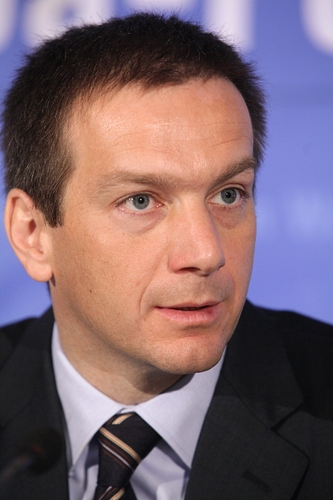
Gordon Bajnai, the Socialist government’s development minister, was nominated to replace outgoing Prime Minister Ferenc Gyurcsány in the early hours of the morning, following desperate, marathon meetings within the Hungarian Socialist Party (MSZP) and the liberal Alliance of Free Democrats (SZDSZ). Assuming that Bajnai’s supporters are able to muster a thin majority in parliament next week, the 41 year old development minister will take over the Hungarian government on April 14, 2009. Yet Bajnai will face major political obstables as prime minister, above and beyond the severe economic crisis which brought Hungary to the brink of bankruptcy.
Gordon Bajnai comes across as telegenic and generally affable in the handful of interviews conducted with him during his brief stint in politics. Bajnai, who is not a member of the Socialist Party and seems to present himself as more of a manager or technocrat, than a party politician, has attempted to put himself above the deep left-right divide that has plagued Hungarian society. In his first statement as the left’s prime ministerial candidate, Bajnai noted that it did not matter to him who stands on the left or on the right of the political spectrum and that he did not want to be seen as a political rival, since he is only willing to take on Hungary’s top job for a limited period of time.
The terms ‘left’ and ‘right’ mean very different things in Hungary these days than just about anywhere else in the democratic world. The Hungarian Socialist Party’s rhetoric on economic policy–and that of the government’s supporters in the media–is akin to what one would hear from Conservatives in Canada or Republicans in the United States. In contrast, Fidesz–Hungary’s largest ‘conservative’ opposition party has suggested that it advocates a third-way economic model, while supporting free public health care and a tuition freeze in universities.
Bajnai will try to tackle Hungary’s economic problems with massive public spending cutbacks totaling 500 billion forints. Whether he will be able to pass any of his proposed legislation in parliament (where Socialist MPs have a record of watering down similar legislation in the past) remains an open question. But even more problematic for Bajnai will be his distinct lack of political legitimacy as prime minister. Not only was Bajnai never elected by popular vote to any political office whatsoever, but the Socialists and Free Democrats only decided to elect him after 17 other potential prime ministerial candidates either rejected the offer for the top job, were turned down by the Free Democrats or were seen as unacceptable by increasingly rebellious Socialist MPs.
Bajnai’s nomination was the closing act of a bizarre political soap opera, which showcased a truly stunning degree of Socialist incompetence. Socialists and Free Democrats spent a week agonizing over who would be Hungary’s next prime minister, in the hope of avoiding an early election which would be disastrous for the MSZP and outright fatal for the SZDSZ. The names of 18 businessmen, bankers, economists, academics and politicians were leaked to the media over a seven day period, prompting these business leaders to issue sometimes shocked rebukes or rejections, as they often found out that the Socialists were pondering their nomination without having first informed the candidate about their plans. Following seven days of failed negotiations, a dozen and a half candidates who did not want the prime ministership–or who were turned down by party politicians–the lethargic Socialists and frantic Free Democrats saw the writing on the wall, and elected Bajnai in their misery. The Socialists accepted Bajnai’s nomination through a “vote of sympathy” on Sunday–in which a third of the the party’s caucus was missing–and the SZDSZ’ leadership voted 7 to 5 to accept the new prime minister at around 1:00AM in Budapest. This only happened after Bajnai reportedly issued an ultimatum, in which he demanded that Free Democrats vote for him before midnight, or else he would withdraw his name, just like all the other candidates. In the end, János Kóka, an SZDSZ MP and Bajnai’s former business partner, convinced his party to support his friend, rather than jump off the deep end in an early election, which would have decimated the liberal party.
Bajnai will find it difficult to counter arguments that Hungary not only suffers from crippling economic problems, but also a huge democratic deficit. While the opposition Fidesz has already indicated that it would continue to push for an early election and would not support any government initiatives–there is dissent within the Socialists and Free Democrats camps as well. Socialist MP József Karsai already confirmed that he does not intend to support Bajnai and that the party’s maneouvering was “pointless.” József Gulyás, an SZDSZ MP, also indicated that he would vote against Bajnai, while three of his colleagues are hesitant to support the new prime minister. For the next 12 months–before the spring 2010 election which will likely bring Fidesz back to power–Bajnai will have to tackle the economy, and deal with the nagging sense of political illegitimacy surrounding his new position. The current political mess will almost certainly come back to bite the Socialists and Free Democrats in European Parliamentary elections set to take place on June 7, 2009.
Christopher Adam
Hungarian exhibit to open at the Montréal Place des Arts
The Hungarian Committee of Montréal and the Embassy of the Republic of Hungary in Ottawa have partnered to organize a historical exhibit at the Place des Arts, with the aim of showcasing some of the most famous embroderies from Hungary, as well as the history of Québec’s Hungarian community. Needlepoint Halas lace is celebrating its 100th anniversary, while the first Hungarians also settled in Montréal a century ago. Hungarian Ambassador Pál Vastagh will open the vernissage, scheduled for 5 April 2009 at 5:00pm with an introductory speech and he will be followed by Andor Csukly, president of the Hungarian Committee of Montréal. Christopher Adam, president of the Montréal Hungarian Historical Society (MHHS) will provide an overview of the history of Hungarians in Québec, in French. The speeches will be followed by a cocktail reception.
Júlia Ciamarra, the retired principal of the Hungarian School of Montréal, served as the exhibit’s local organizer. The Government of Québec’s Ministry of Immigration and Cultural Communities is among the exhibit’s sponsors.
The exhibit can be viewed from April 6-12, 2009, between 11:00am and 6:00pm, at Montréal’s Place des Arts.
Magyar kiállítás Montreálban
Magyar vonatkozású kiállítás kerül megrendezésre a montreáli Place des Arts-ban, melynek során megismerkedhet a helyi francia és angol lakosság a világhírű halasi csipkével, valamint a Québec tartománybeli magyarság történelmével. A 100 éves halasi csipke legszebb példái kerülnek bemutatára, a Montreáli Magyar Történelmi Társaság által készített, a magyar közösség múltját ismertető tablóival együtt. A kiállítást a Montreáli Magyar Bizottság és a Magyar Köztársaság Ottawai Nagykövetsége közösen szervezi. Az ünnepélyes megnyításra 2009 április 5-én (vasárnap), d.u. 5 órakor kerül sor. Ezt követően pedig a szervezők koktél-fogadásra hívják a vendégeket. A rendezényt Vastagh Pál nagykövet nyítja meg és szintén felszólal Csukly Andor, a Montreáli Magyar Bizottság elnöke, valamint Ádám Christopher, a Montreáli Magyar Történelmi Társaság elnöke. A kiállítás helyi szervezője Ciamarra Júlia és a költségekhez a québeci kormány is hozzájárult.
2009. április 6-12 között tekinteni meg a kiállítást, reggel 11-től este 6 óráig a Place des Arts színház halljában.
Kanadai Magyar Hírlap
Pacific Cinémathèque to screen Miklós Jancsó films in Vancouver

Miklós Jancsó
Pacific Cinémathèque is preparing to present a four-film retrospective on Miklós Jancsó, among the great directors of 1960s European cinema. One of the masters of widescreen composition and elaborately choreographed long-take sequence shots, Jancsó’s fervid, transfixing, highly stylized and intensely formalist films are noted for their balletic, brutal study of repression, rebellion and revolution. Power and politics are destructive forces in Jancsó’s singular cinema, which is highly allegorical and can approach abstraction in its use of ritual, spectacle, massive scale and geometrical patterning to depict human events. His dramas explore, obsessively, turbulent events of Hungary’s past history; the historical settings serve as pretexts for Jancsó’s true subjects: repression in the contemporary, post-1956 Hungary in which he lived; and, more universally, our capacity as humans to inflict very great cruelty upon one another.
Jancsó was the recipient of a Special Prize for his entire body of work at Cannes in 1979 (he had won the festival’s Best Director award in 1972 for Red Psalm), and was accorded a similar honour – a Golden Lion for Lifetime Achievement – at Venice in 1990. It is no exaggeration to say that he was one of the world’s leading filmmakers in the 1960s and early 1970s. That Jancsó is less well known today speaks to the shifting winds of critical fashion, but also reflects the fact that his films – which demand to be viewed on the big screen – have simply become difficult to see: good 35mm prints of Jancsó ‘s works have not been available in Canada or the U.S. for decades. This presentation features new 35mm prints, imported from Hungary, of four of Jancsó’s greatest achievements.
The four films to be screen in Vancouver include The Round-Up (1965), The Red and the White (1967), Red Psalm (1972), as well as Silence and Cry (1967). All four films are in Hungarian, with English subtitles.
The Round-Up (Szegénylegények)
Miklós Jancsó’s international breakthrough came with this unusual, hypnotic historical drama, hailed by fellow Magyar director Zoltán Fábri as “perhaps the best Hungarian film which has ever been made.” In the 1860s, forces of the Austro-Hungarian Empire round up a group of peasants and, through a ritualistic process of interrogation, torture and execution, attempt to weed out partisans who had participated in Hungary’s 1848 revolt against Habsburg rule.
The Red and the White (Csillagosok, katonák)
Miklós Jancsó was commissioned by the Soviets to make a film commemorating the 50th anniversary of the Russian Revolution. A co-production between Hungary and the USSR, the film is set during the Civil War that followed the Revolution, and concerns a group of Hungarian volunteers fighting for the Bolshevik side against White Russian forces. An epic back-and-forth struggle unfolds on a vast, expansive plain; each side commits atrocities as it gains the upper hand. The film showcases Jancsó’s gift for panoramic pageantry, intricate camera movement, and geometric abstraction, and his interest in the rituals of power, the mechanics of dominance and submission. Neither the extreme formalism nor the anti-heroic content could have thrilled the Soviets, who first re-edited the film and then banned it.
Red Psalm (Még kér a nép)
Jancsó won Best Director honours at Cannes for this dizzying, dazzling film which recounts, in fervid, balletic, bloody fashion, and with much pageantry (and nudity), a farm workers’ rebellion on a large Hungarian estate in the late 19th century. Jancsó’s circling, swirling, incessantly moving camera captures the drama with breathtaking kinetic and metaphoric force; this 88-minute film is composed of a mere 28 shots, each demonstrating the director’s bold, rhythmic command of the expressive extended take.
Silence and Cry (Csend és Kiáltás)
An elliptical, claustrophobic drama shot in the brilliant, breathtaking long takes that are Jancsó’s trademark, Silence and Cry is set after the fall of the short-lived Hungarian Soviet Republic of 1919. A young Red soldier, fleeing the anti-Communist manhunt, takes refuge at the isolated farm of a peasant family. His reluctant hosts are already under police scrutiny for being politically suspect. The local White commander is aware of the soldier’s presence but, for personal reasons, keeps it a secret. The soldier discovers that the farmer is being poisoned, slowly, by his wife and her sister.
Screenings will take place April 1-6, 2009. For more precise screening dates and times, call: 1-604 688 FILM.
Hungarian prime minister announces imminent resignation
Ferenc Gyurcsány, Hungary’s longest serving prime minister since the country’s transition to democracy twenty years ago, suprised even the most avid political analysts by announcing his imminent resignation. Gyurcsány spoke at the Hungarian Socialist Party’s congress, where he recommended that the left-centre party form a new government, headed by a new prime minister. “I misjudged our strength and the opportunities before us and I did not offer a clear and straightforward speech at a critical moment. As such, my credibility decreased significantly”–Gyurcsány told party delegates.
Gyurcsány will call for a vote of confidence in parliament this coming week, which he is almost certain to lose, in light of the fact that the four opposition parties hold a majority in the Hungarian national legislature. The liberal Alliance of Free Democrats (SZDSZ) has been calling for Gyurcsány’s resignation for a year, when it decided to leave the governing coalition. The largest opposition party, the right-leaning Fidesz, as well as the Christian Democratic Peoples’ Party (KDNP) and the centrist Hungarian Democratic Forum (MDF) have called for Gyurcsány’s resignation over the years. Fidesz, however, is also adamant that new national elections be held on 7 June 2009, in conjunction with the European Parliamentary (EP) vote. The national vote would otherwise be scheduled for spring 2010.
All polls suggest that the Socialists stand to suffer a massive defeat, with Fidesz scooping up all but 5 or 6 of the 22 seats allocated to Hungary in the European Parliament. The deeply unpopular prime minister’s resignation, however, may offer the Socialist Party a glimmer of hope that left-centre voters–especially pensioners–might be re-engaged and convinced to vote. There has also been talk of a so-called “olive branch coalition” between the Socialists, the SZDSZ and the MDF, especially if the country’s new prime minister is independent of these parties and is seen as capable of handling Hungary’s dire economic situation. The MDF recently tried to nominate Lajos Bokros, a former finance minister in Prime Minister Gyula Horn’s Socialist government and the conservative opposition party’s main candidate in the upcoming EP elections, as prime ministerial candidate to replace Gyurcsány, but with no success. While the SZDSZ would probably support a Bokros prime ministership, the left-wing Socialists almost certainly would not, nor would Fidesz or the KDNP. Bokros holds neo-liberal economic views, calling for radical austerity measures and deep cuts to pensions, health care and education.
Even if Gyurcsány is replaced in the next two weeks, he will stay on as Socialist Party president. “Despite all of our shortcomings and our weakness, we stood on the right side,” Gyurcsány told party faithful in what may now be his last major address as prime minister.
The Hungarian economy is currently the most fragile in the European Union. The country’s debt-to-GDP ratio stands at an estimated 73 percent and is expected to rise to over 80 percent by early next year.
Canadian Hungarian Journal
Hungarian PM warns European Union of new Iron Curtain

Ferenc Gyurcsány
Hungarian Prime Minister Ferenc Gyurcsány warned the leaders of western European Union member states not to erect a new Iron Curtain by permitting Eastern European economies to collapse under the pressure of the global financial crisis. “We should not allow that a new Iron Curtain should be set up and divide Europe. In the beginning of the nineties we reunified Europe, now the challenge is whether we will be able to reunify Europe financially”–Gyurcsány observed, while attending the EU’s emergency summit this weekend. The Hungarian Socialist prime minister’s words were significant enough to echo on this side of the Atlantic as well, with the Canadian Broadcasting Corporation (CBC) featuring Gyurcsány’s warning as headline news on its website.
Hungary has led a move on the part of other East/Central European countries–namely Poland and the Czech Republic–to pursuade the EU to provide the region with a massive bail-out package, in order to cushion these struggling economies from the impact of dramatically declining currencies and–particularly in Hungary’s case–crippling national debts and a sizeable deficit. Polish Prime Minister Donald Tusk noted that the West must adopt a “spirit against protectionism and egoism.” Czech Prime Minister Mirek Topolanek echoed his Polish and Hungarian counterparts when he noted that the region does not want “a Europe divided along a North-South or an East-West line” and also observed that a “beggar-thy-neighbour policy is unacceptable.”
Hungary has called on the EU to provide Eastern Europe with a massive €180 billion loan, but it appears as though key western European leaders are hesitant to do this. German Chancellor Angela Merkel rejected the idea of a blanket bail-out for any region, noting instead that the situation is dramatically different in each country and that a one-size-fits-all solution would not make sense. In many ways, Merkel’s assessment is quite accurate. Hungary is in the worst situation, as a liquidity crisis looms over what was once the most prosperous country in the former communist Eastern bloc. Hungary’s national debt now stands at well over 60 percent of the GDP and particularly problematic is the fact that the Hungarian forint’s value has slipped by more than 20 percent over the past months, leaving millions of Hungarians who took up mortgages or car loans in Swiss francs and euros in a bind. Yet widespread defaults and personal bankruptcies in Hungary would send Austria’s economy into a free fall as well, since major Austrian banks dominate Hungary’s banking sector. In fact, were Hungary to effectively declare bankruptcy and default on its national debt, it would likely drag the entire European common market and currency down with it.
It seems doubtful that Gyurcsány will receive all that he asked for. In fact, his request that Hungary’s adoption of the euro be fast-tracked in light of the crisis has already been rejected by Luxembourg’s Prime Minister, Jean-Claude Juncker, who noted that it is impossible to change euro zone accession criteria “overnight.” Additionally, there is a sense that the EU will not provide more aid beyond the €25 billion which was announced last week by the World Bank and the European Investment Bank, which aims to shore up Eastern Europe’s teetering banking sector. This, however, may be too little, too late for Gyurcsány, whose Socialist Party must face a deeply disenchanted electorate on 7 June 2009 for European Parliamentary elections. Hungary is allocated 22 seats in the European Parliament. Most public opinion polls suggest that the Socialists are unlikely to garner more than 6 of these, with the rest going to one or possibly two opposition conservative parties.
Canadian Hungarian Journal
The Lublin Cold War history conference in photos

The Hungarian Panel

Christopher Adam

András Fejérdy

Ferenc Cseresnyés

Magdolna Baráth

Slawomir Lukasiewicz

Chris Kostov

Jan Raska

"Willkommen in der DDR!" -- A relic from the past, during the East German panel

Chris Kostov, Christopher Adam and Jan Raska in Lublin

Christopher Adam and Chris Kostov in Lublin
Russian state buys stake in Malév Hungarian Airlines

Russian state buys stake in Malév
The on-going saga of Hungary’s troubled flag carrier, Malév, entered another chapter, with news that the Russian state has indirectly purchased a stake in the badly indebted airline. Vnyesekonombank, a state-owned Russian financial institution, is reportedly preparing to take control of a 49 percent stake in AirBridge Zrt., the company which owns Malév Hungarian Airlines. In order to ensure that Malév retains its status as Hungary’s national airline and, by extension, does not have to forfeit its European Union operating license, Magdolna Költő and Kálmán Kiss–two Hungarian businesspeople–will together control 51 percent of the company’s shares. János Veres, Hungary’s finance minister, met with Russian Deputy Prime Minister Victor Zubor and confirmed that the airline’s new structure will safeguard its Hungarian national status. The new arrangement became necessary after Boris Abramovich, the Russian businessman who purchased Malév in 2007 following its privatization by Hungary’s Socialist government, failed to satisfy most conditions of the agreement and was removed from AirBridge Zrt’s executive.
Despite the assurances, there is no doubt that Russian state interests will now dominate Malév. According to the terms of the new deal, the Hungarian flag carrier will strike a partnership with Aeroflot, Russia’s state-owned national airline. Malév is struggling under the weight of a debt, which has now reportedly reached 20 billion forints. The Hungarian flag carrier owes Budapest Airport Zrt nearly 10 billion forints and since the airline was unable to service its debt in a timely manner, the company had to cede its 15 percent stake in one of its smaller firms, Malév-Lufthansa Technik Kft, and hand ownership over to Budapest Airport’s operator. Additionally, Malév also owes 600 million forints (€2.2 million) to Malév Vagyonkezelő Kft, a Hungarian state-owned company which controls the Malév trademark and owns a gas pipe line running between Budapest’s Ferihegy Airport and the town of Százhalombatta, as well as a Boeing 767-200 aircraft.
Malév currently operates a fleet of 27 aircraft, including 18 Boeing 737 planes, and a handful of smaller, regional aircraft. The airline flies to 50 destinations from its base at Budapest Ferihegy Airport, including regular flights to Tel Aviv (Israel), Beirut (Lebanon) and Damascus (Syria).
Canadian Hungarian Journal
Canadian Hungarian Artists Collective screens films in Montreal
The Canadian Hungarian Artists’ Collective (CHAC) is organizing a film screening and pot luck dinner on February 18th, 2009 at the Youth Centre located next to Our Lady of Hungary Church, in Montreal. The event will focus on a handful of short films, including Peter Horvath’s “Tenderly Yours” and “The Boulevard,” as well as Clarissa Schmidt Inglis’ “Stories of Life.” All three films were produced in 2008. Two other, slightly longer documentary films will also be screened, both of which were produced by Sofie Fekete, a Québec-based artist of Hungarian origins, and a long-time CHAC member. These films include “Tantramar 07,” as well as “Bolondos Two.”
While CHAC is not charging any entry fees, the suggested donation is $5. The pot luck dinner will begin at 6.30 and will be followed by the screenings at 7.30. The Youth Centre is located at 90, rue Guizot Ouest. Those who rely on public transit can take Bus 55, which stops at the corner of Guizot and Boulevard St. Laurent, or the orange metro line to the Jarry station, located a 10 minute walk from the Our Lady of Hungary Church and Youth Centre.
Canadian Hungarian Journal

3 comments